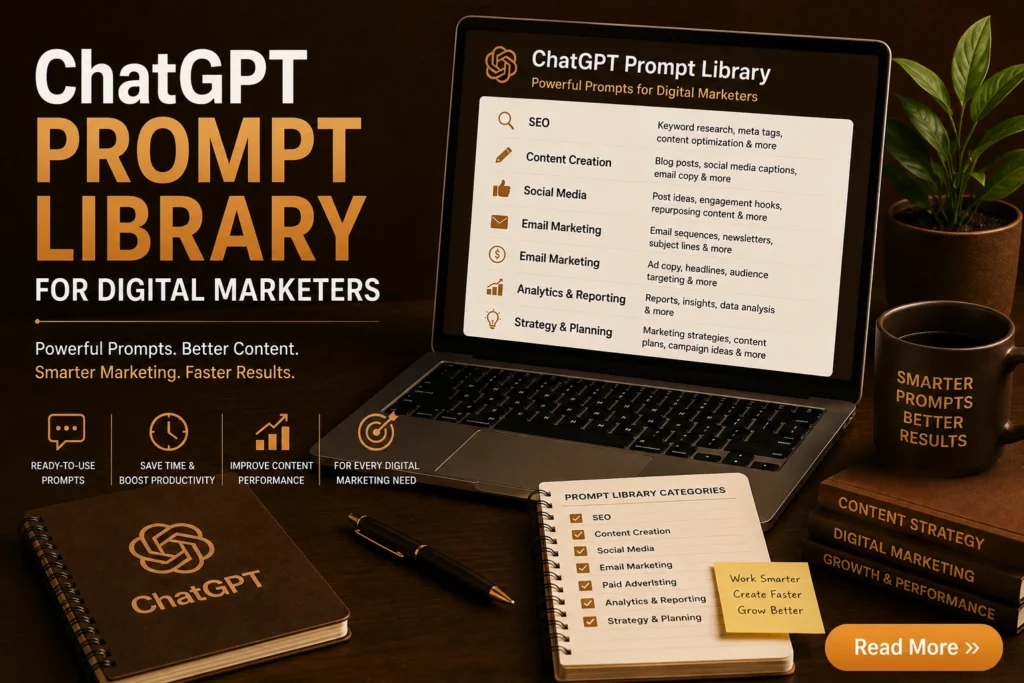
ChatGPT Prompt Library for Digital Marketers
Introduction: Why Every Marketer Needs a Prompt Library Digital marketers increasingly rely on artificial intelligence to accelerate their daily workflows, yet many still struggle to extract consistently useful output from tools like ChatGPT. This challenge typically stems not from the tool itself, but from poorly structured prompts that fail to communicate context, tone, and objective clearly. Consequently, building a reliable ChatGPT prompt library for digital marketers becomes essential for anyone seeking to scale content production without sacrificing quality. A well-organized prompt library transforms ChatGPT from a generic chatbot into a dependable creative and strategic partner. Based on real-world application across SEO, content, and paid media campaigns, the prompts below have been tested and refined for practical, day-to-day use rather than theoretical demonstration. Therefore, this article presents a structured collection of proven prompts across nine core marketing functions, along with the reasoning behind each one. By the end, marketers will possess a practical, ready-to-use toolkit that saves time while consistently producing higher-quality results. Section 1: Understanding the Fundamentals of Effective Prompting Before exploring specific prompts, marketers must first understand what separates an effective prompt from a mediocre one. Specifically, strong prompts include clear context, a defined role for the AI, a specific task, and constraints around tone, length, and format. Without these elements, ChatGPT often produces generic, unfocused responses that require significant editing. Moreover, iterative refinement plays a crucial role in prompt engineering, since the first response rarely represents the final, usable output. Instead, marketers should treat each prompt as a starting point, refining wording and adding constraints based on the initial results. As a result, mastering these fundamentals ensures that every prompt within the library consistently delivers value rather than requiring constant rework. Section 2: SEO Research and Keyword Discovery Prompts Search engine optimization tasks consume significant time, particularly during the research phase, which makes AI assistance especially valuable here. For instance, a prompt such as “Act as an SEO strategist and generate 20 long-tail keyword ideas for [topic], grouped by search intent” quickly surfaces organized keyword opportunities. This structured approach saves hours compared to manual brainstorming. Additionally, prompts designed to analyze competitor content gaps prove equally valuable. A prompt like “Compare the following three competitor articles on [topic] and identify subtopics they failed to cover” helps marketers identify opportunities for more comprehensive content. Consequently, these SEO-focused prompts allow teams to conduct preliminary research faster, freeing up time for deeper strategic analysis. Section 3: Content Creation and Blog Writing Prompts Content creation represents one of the most common use cases for ChatGPT among marketers, yet generic prompts often produce bland, generic writing. Instead, effective prompts specify audience, tone, structure, and desired outcome explicitly. For example, “Write a 300-word introduction for a blog post about [topic], targeting [audience], using a conversational tone that highlights a common pain point” produces far more usable results than a vague request. Furthermore, outline-generation prompts help marketers structure long-form content before writing begins. A prompt such as “Create a detailed blog outline for [topic] with nine sections, each addressing a distinct subtopic relevant to [target audience]” mirrors the structured approach used throughout this very article. In this way, content creation prompts accelerate the writing process while maintaining logical, reader-friendly structure. Section 4: Social Media Caption and Content Prompts Social media demands a high volume of consistently engaging content, which makes this category one of the most frequently used sections within any prompt library. A prompt like “Generate five Instagram captions for [product/service] that use a friendly tone, include a call-to-action, and stay under 150 characters” produces platform-appropriate content quickly. This specificity prevents generic, overly formal captions that fail to resonate on social platforms. In the same vein, prompts tailored to specific platforms yield noticeably better results than generic requests. For example, “Write three LinkedIn posts about [industry trend], using a professional tone with a hook in the first line” acknowledges the distinct expectations of a professional audience. Consequently, platform-specific prompting ensures that content aligns naturally with each channel’s tone and format expectations. Section 5: Ad Copywriting and Performance Marketing Prompts Writing high-converting ad copy requires balancing brevity with persuasive messaging, a task well-suited to AI assistance when prompts are structured correctly. A prompt such as “Write five Google Ads headlines under 30 characters for [product], emphasizing [key benefit], following AIDA principles” generates multiple testable variations quickly. This variation generation proves particularly valuable for A/B testing campaigns. Additionally, prompts focused on audience-specific messaging help marketers tailor ad copy for different buyer personas. A prompt like “Rewrite this ad copy for a budget-conscious audience versus a premium-focused audience” produces two distinct versions ready for segmented campaigns. As a result, ad copywriting prompts significantly reduce the time required to produce multiple creative variations for performance testing. Section 6: Email Marketing and Newsletter Prompts Email marketing benefits substantially from AI assistance, particularly when crafting subject lines and structuring newsletter content. For instance, “Generate ten subject lines for an email announcing [product/offer], optimized for high open rates and under 50 characters” quickly produces testable options. Since subject lines directly influence open rates, this prompt category delivers immediate practical value. Moreover, prompts that structure entire email sequences help marketers plan multi-touch campaigns efficiently. A prompt such as “Create a five-email welcome sequence for new subscribers to [business type], each email building toward a specific call-to-action” outlines a complete nurture sequence in minutes. Consequently, email marketing prompts streamline both individual message creation and broader campaign planning. Section 7: Customer Persona and Market Research Prompts Developing accurate audience personas requires synthesizing significant amounts of research, a process that AI can meaningfully accelerate. A prompt like “Based on the following customer data, create a detailed buyer persona including demographics, pain points, and buying triggers” helps organize research into a usable format. This structured synthesis saves considerable time during the strategic planning phase. Furthermore, prompts designed to simulate customer objections help marketing teams prepare more persuasive messaging in advance. For example, “List the top five objections a [persona type] might have before purchasing [product], along